
Private AI Search in Oracle APEX: Data In-House, Tenants Apart
AI search inside the Oracle database, with no outside AI service. I check what really leaves the server, show how one forgotten WHERE clause leaks another franchise's data, and close that gap with Virtual Private Database. Plus an honest look at what this kind of AI can not do.
After part 3 I showed the search page to people who run businesses, not databases. The questions were the same every time. If the AI sits inside our database, does that mean our data stays with us and we do not depend on an American AI service? We have franchises. Can the AI show one franchise owner the customers of another? And can I simply ask it who my strongest customer was?
Fair questions. This post answers all three, on the same demo stack as parts 1 to 3, with every script run for real. Short version. Yes, the data stays. Yes, it can leak between tenants, but not because of the AI, and one database feature closes it for good. And no, this kind of AI can not tell you your best customer.

Part 1 installed Oracle AI Database 26ai Free, ORDS and APEX 26.2 in Docker. Part 2 loaded the embedding model into the database. Part 3 built the Smart Search page. Everything here runs on exactly that stack. No new container, no language model.
What the AI in the Database Really Is
"AI in the database" sounds like a chat bot living next to your tables. It is not. What parts 2 and 3 put into Oracle is an embedding model. It does exactly one thing. It turns a piece of text into a list of 384 numbers that describe its meaning. Two texts with a similar meaning get similar numbers, and the database can measure that distance. That is the whole trick behind the search.
Look at the Model
The model is a database object like a table or a package. You can query it, grant it and back it up.
-- What the "AI" in the database really is: one embedding model, stored like any other object.
set lines 150 pages 50 feedback off
col owner format a13
col model_name format a20
col mining_function format a10
col algorithm format a10
col size_mb format 990.0
select owner, model_name, mining_function, algorithm, round(model_size / 1024 / 1024, 1) as size_mb
  from all_mining_models;

col dims format 9990
col first_values format a60
select vector_dimension_count(v) as dims,
       substr(from_vector(v returning clob), 1, 52) || '...' as first_values
  from (select vector_embedding(apexnote_vec.all_minilm_l12_v2
                 using 'The customer was billed twice this month' as data) as v
          from dual);
OWNER         MODEL_NAME           MINING_FUN ALGORITHM  SIZE_MB
------------- -------------------- ---------- ---------- -------
APEXNOTE_VEC  ALL_MINILM_L12_V2    EMBEDDING  ONNX         127.1

 DIMS FIRST_VALUES
----- ------------------------------------------------------------
  384 [-4.81662303E-002,4.34131473E-002,-4.3135602E-002,4....

| The embedding model can | The embedding model can not |
|---|---|
| Find records by meaning, not by exact words | Answer a question in sentences |
| Find duplicates and similar records | Calculate sums, totals or rankings |
| Group texts by topic | Remember anything between two queries |
| Give the best context to a language model later (RAG) | Decide who may see which row |
The model was trained once, years ago, on public text. It never learns from your data and it keeps nothing between two calls. Every call is pure math on the text you pass in. That matters for the franchise question later.
Part A. Does Anything Leave the Server?
"The data stays in the database" is easy to write. I wanted to see it. Oracle controls every outgoing network connection from PL/SQL with access control lists. If a schema has no entry, it can not open a connection. Not to OpenAI, not to anybody.
Who May Talk to the Network?
-- Who may open network connections from this database at all?
set lines 150 pages 50 feedback off
col host format a10
col principal format a20
col privilege format a10
select host, principal, privilege from dba_host_aces order by principal;
HOST       PRINCIPAL            PRIVILEGE
---------- -------------------- ----------
*          APEX_260200          CONNECT
*          GSMADMIN_INTERNAL    RESOLVE

APEXNOTE, the schema behind the app. The APEX_260200 entry came with the APEX install of the ORDS container, I did not add it.APEX_260200 with CONNECT on * means APEX itself may call any host. That is what APEX_WEB_SERVICE and REST Data Sources use. The search in this series does not use them, but if your app calls a web service somewhere, that call can leave the server. Check dba_host_aces on your own system and narrow it to the hosts you really need.
Try to Reach the Internet, Then Search
Now the real test. As the application schema I try to call an AI service directly, and right after that I run the semantic search from part 3 in the same session.
-- The application schema can not reach the internet, and the search still works.
set lines 150 pages 50 feedback off serveroutput on
begin
  dbms_output.put_line(substr(utl_http.request('https://api.openai.com/'), 1, 80));
end;
/
col title format a52
col match_pct format 990
with question as (
  select vector_embedding(apexnote_vec.all_minilm_l12_v2 using 'customers get duplicate bills by e-mail' as data) as v
    from dual
)
select t.title, round((1 - vector_distance(t.search_vec, question.v, cosine)) * 100) as match_pct
  from demo_tasks t, question
 order by vector_distance(t.search_vec, question.v, cosine)
 fetch first 3 rows only;
begin
*
ERROR at line 1:
ORA-29273: HTTP request failed
ORA-06512: at "SYS.UTL_HTTP", line 1594
ORA-24247: network access denied by access control list (ACL)

TITLE                                                MATCH_PCT
---------------------------------------------------- ---------
Invoices arrive twice in the customer mailbox               52
Duplicate tasks are created twice                           33
Fix ORA-01555 in the monthly sales report                   20

What this means for data protection
I am not a lawyer, so read this as a technical view. For this search no text and no personal data goes to an outside AI provider. There is no extra processor to sign a data processing agreement with, and no transfer to a third country for this feature. The data is where it was before, in your database on your server.
Two honest limits. Oracle is an American company, so the software itself is from the US, even when it runs on your server in Germany. And the database still needs everything it needed before. Hosting contract, access rights, backups, a deletion concept. The AI part does not make that worse, it just does not add a new place where data goes.
Part B. One Database, Many Franchises
Now the question that worried people most. One app, one database, several franchises. Can the AI show the Frankfurt owner a customer from Hamburg? To test it I built a small franchise in the demo database. A cleaning company with two branches, customer notes and orders.
Franchise Tables and Sample Data
Every row carries a FRANCHISE_ID. The notes get a vector column and a trigger, exactly like the tasks in part 3. A small mapping table says which APEX user belongs to which franchise.
-- A small franchise: one database, one app, two branches. Every row belongs to exactly one franchise.
set lines 150 pages 50 feedback on timing off
create table franchises (
  id    number primary key,
  name  varchar2(50) not null
);
insert into franchises values (1, 'Frankfurt');
insert into franchises values (2, 'Hamburg');

create table franchise_users (
  username      varchar2(100) primary key,
  franchise_id  number not null references franchises
);
insert into franchise_users values ('FRANKFURT_MANAGER', 1);
insert into franchise_users values ('HAMBURG_MANAGER',   2);

create table franchise_notes (
  id            number generated always as identity primary key,
  franchise_id  number not null references franchises,
  customer      varchar2(60) not null,
  note          varchar2(1000) not null,
  created_on    date default on null sysdate not null,
  note_vec      vector(384, float32)
);

create or replace trigger franchise_notes_vec_biu
  before insert or update of customer, note on franchise_notes
  for each row
begin
  select vector_embedding(apexnote_vec.all_minilm_l12_v2 using :new.customer || '. ' || :new.note as data)
    into :new.note_vec
    from dual;
end;
/

create table orders (
  id            number generated always as identity primary key,
  franchise_id  number not null references franchises,
  customer      varchar2(60) not null,
  order_date    date not null,
  amount        number(10,2) not null
);
-- Similar problems in both branches, different customers. Exactly the case where a search can mix them up.
set lines 150 pages 50 feedback off timing on
insert into franchise_notes (franchise_id, customer, note) values (1, 'Mainblick Dental Practice', 'The customer says the invoice for September arrived twice and was paid twice. Refund the second payment.');
insert into franchise_notes (franchise_id, customer, note) values (1, 'Mainblick Dental Practice', 'Cleaning team arrived 40 minutes late on Monday. Practice manager was unhappy because patients were already waiting.');
insert into franchise_notes (franchise_id, customer, note) values (1, 'Westend Law Office', 'Office key was not returned after the evening shift. Key is now in the branch safe.');
insert into franchise_notes (franchise_id, customer, note) values (1, 'Westend Law Office', 'Customer wants a fixed quote for window cleaning twice a year.');
insert into franchise_notes (franchise_id, customer, note) values (1, 'Sachsenhausen Bakery', 'Floor in the sales room was still wet when the shop opened. A customer almost slipped.');
insert into franchise_notes (franchise_id, customer, note) values (1, 'Sachsenhausen Bakery', 'Contract renewal for next year agreed by phone, waiting for the signed copy.');
insert into franchise_notes (franchise_id, customer, note) values (1, 'Ostend Fitness Studio', 'Showers in the changing rooms smell of mould. Customer asks for a deep clean.');
insert into franchise_notes (franchise_id, customer, note) values (1, 'Ostend Fitness Studio', 'Alarm system went off at 5 am because the cleaner used the wrong code.');
insert into franchise_notes (franchise_id, customer, note) values (1, 'Bockenheim Kita', 'Parents complained about strong cleaning product smell in the group rooms.');
insert into franchise_notes (franchise_id, customer, note) values (1, 'Bockenheim Kita', 'Customer pays always 30 days late. Send a friendly reminder before the next invoice.');
insert into franchise_notes (franchise_id, customer, note) values (2, 'Alster Tax Advisors', 'Customer reports that the October invoice was sent two times by e-mail. Check the billing run.');
insert into franchise_notes (franchise_id, customer, note) values (2, 'Alster Tax Advisors', 'Cleaner came one hour late, the office was already full of clients.');
insert into franchise_notes (franchise_id, customer, note) values (2, 'Harbour Coffee Roasters', 'Grease on the kitchen floor was not removed. Customer sent photos.');
insert into franchise_notes (franchise_id, customer, note) values (2, 'Harbour Coffee Roasters', 'Customer cancels the Saturday cleaning from December on.');
insert into franchise_notes (franchise_id, customer, note) values (2, 'Eppendorf Physio Centre', 'Treatment rooms need disinfection after every shift, new hygiene plan attached.');
insert into franchise_notes (franchise_id, customer, note) values (2, 'Eppendorf Physio Centre', 'Front door was left unlocked after cleaning on Friday night.');
insert into franchise_notes (franchise_id, customer, note) values (2, 'Altona Co-Working', 'Customer wants to double the cleaning hours, ask for a new offer.');
insert into franchise_notes (franchise_id, customer, note) values (2, 'Altona Co-Working', 'Toilet paper and soap were not refilled for a whole week.');
insert into franchise_notes (franchise_id, customer, note) values (2, 'Speicherstadt Gallery', 'Paintings must not be touched, only dry dusting of the frames.');
insert into franchise_notes (franchise_id, customer, note) values (2, 'Speicherstadt Gallery', 'Last two invoices are still open, the customer asked for a payment plan.');
commit;

insert into orders (franchise_id, customer, order_date, amount)
select f.franchise_id, f.customer,
       trunc(sysdate, 'MM') - (level - 1) * 30 + mod(level * 7, 20) as order_date,
       round(f.base * (0.85 + mod(level * 13, 30) / 100), 2) as amount
  from (select 1 franchise_id, 'Mainblick Dental Practice' customer, 1850 base from dual union all
        select 1, 'Westend Law Office',      2400 from dual union all
        select 1, 'Sachsenhausen Bakery',     980 from dual union all
        select 1, 'Ostend Fitness Studio',   3100 from dual union all
        select 1, 'Bockenheim Kita',         1450 from dual union all
        select 2, 'Alster Tax Advisors',     2750 from dual union all
        select 2, 'Harbour Coffee Roasters', 1200 from dual union all
        select 2, 'Eppendorf Physio Centre', 2100 from dual union all
        select 2, 'Altona Co-Working',       4300 from dual union all
        select 2, 'Speicherstadt Gallery',    890 from dual) f
connect by level <= 6
       and prior f.customer = f.customer
       and prior sys_guid() is not null;
commit;
set timing off

col franchise format a10
select f.name as franchise,
       (select count(*) from franchise_notes n where n.franchise_id = f.id) as notes,
       (select count(case when n.note_vec is not null then 1 end) from franchise_notes n where n.franchise_id = f.id) as with_vector,
       (select count(*) from orders o where o.franchise_id = f.id) as orders
  from franchises f order by f.id;
FRANCHISE       NOTES WITH_VECTOR     ORDERS
---------- ---------- ----------- ----------
Frankfurt          10          10         30
Hamburg            10          10         30

The Leak
The Frankfurt manager asks about a customer who received the same invoice twice. The query is the search from part 3, pointed at the notes. It has no franchise filter. Not because I am careless, but because this is exactly the line that gets lost when a page is copied, a report is added in a hurry or a developer tests something.
-- The Frankfurt manager asks a question. The query has no franchise filter, because somebody forgot one line.
set lines 160 pages 50 feedback off
col franchise format a10
col customer format a26
col note format a70 trunc
col match_pct format 990
variable q varchar2(200)
exec :q := 'customer received the same invoice twice'
with question as (
  select vector_embedding(apexnote_vec.all_minilm_l12_v2 using :q as data) as v from dual
)
select f.name as franchise, n.customer, n.note,
       round((1 - vector_distance(n.note_vec, question.v, cosine)) * 100) as match_pct
  from franchise_notes n
  join franchises f on f.id = n.franchise_id, question
 order by vector_distance(n.note_vec, question.v, cosine)
 fetch first 4 rows only;
FRANCHISE  CUSTOMER                   NOTE                                                                   MATCH_PCT
---------- -------------------------- ---------------------------------------------------------------------- ---------
Hamburg    Alster Tax Advisors        Customer reports that the October invoice was sent two times by e-mail        68
Frankfurt  Mainblick Dental Practice  The customer says the invoice for September arrived twice and was paid        66
Hamburg    Speicherstadt Gallery      Last two invoices are still open, the customer asked for a payment pla        42
Hamburg    Altona Co-Working          Customer wants to double the cleaning hours, ask for a new offer.             38

The model only compared texts. It returned Hamburg because the query allowed Hamburg. A normal LIKE search or a classic report with the same missing WHERE leaks the same rows. So the fix does not belong in the AI. It belongs in the database, where nobody can forget it.
Virtual Private Database
Virtual Private Database, VPD for short, lets Oracle add a WHERE condition to every statement on a table. Select, insert, update, delete. The application does not see it and can not skip it. The condition comes from a policy function. Mine asks APEX who is logged in, through the context APEX$SESSION that APEX fills on every request, and looks up the franchise of that user.
First try, straight as the application schema.
-- First try: add the policy as the application schema.
set lines 150 pages 50 feedback on
create or replace function franchise_policy (
  p_schema in varchar2,
  p_object in varchar2
) return varchar2
is
begin
  return 'franchise_id = (select fu.franchise_id from franchise_users fu '
      || 'where fu.username = sys_context(''APEX$SESSION'', ''APP_USER''))';
end;
/
begin
  dbms_rls.add_policy(
    object_schema   => 'APEXNOTE',
    object_name     => 'FRANCHISE_NOTES',
    policy_name     => 'FRANCHISE_NOTES_SEP',
    function_schema => 'APEXNOTE',
    policy_function => 'FRANCHISE_POLICY',
    statement_types => 'select, insert, update, delete',
    update_check    => true,
    policy_type     => dbms_rls.shared_static);
end;
/
Function created.

    policy_type     => dbms_rls.shared_static);
                       *
ERROR at line 10:
ORA-06550: line 10, column 24:
PLS-00201: identifier 'DBMS_RLS' must be declared
ORA-06550: line 2, column 3:
PL/SQL: Statement ignored
-- The application schema needs the right to manage policies. That is a DBA decision, so it is a grant.
set lines 150 pages 50 feedback on
grant execute on dbms_rls to apexnote;
-- One policy function, used for the notes and the orders. The predicate is added to EVERY statement on these tables.
set lines 150 pages 50 feedback on
begin
  dbms_rls.add_policy(
    object_schema   => 'APEXNOTE',
    object_name     => 'FRANCHISE_NOTES',
    policy_name     => 'FRANCHISE_NOTES_SEP',
    function_schema => 'APEXNOTE',
    policy_function => 'FRANCHISE_POLICY',
    statement_types => 'select, insert, update, delete',
    update_check    => true,
    policy_type     => dbms_rls.shared_static);
  dbms_rls.add_policy(
    object_schema   => 'APEXNOTE',
    object_name     => 'ORDERS',
    policy_name     => 'ORDERS_SEP',
    function_schema => 'APEXNOTE',
    policy_function => 'FRANCHISE_POLICY',
    statement_types => 'select, insert, update, delete',
    update_check    => true,
    policy_type     => dbms_rls.shared_static);
end;
/
col object_name format a16
col policy_name format a20
col function format a17
select object_name, policy_name, function, sel, ins, upd, del, enable
  from user_policies order by object_name;
PL/SQL procedure successfully completed.

OBJECT_NAME      POLICY_NAME          FUNCTION          SEL INS UPD DEL ENA
---------------- -------------------- ----------------- --- --- --- --- ---
FRANCHISE_NOTES  FRANCHISE_NOTES_SEP  FRANCHISE_POLICY  YES YES YES YES YES
ORDERS           ORDERS_SEP           FRANCHISE_POLICY  YES YES YES YES YES
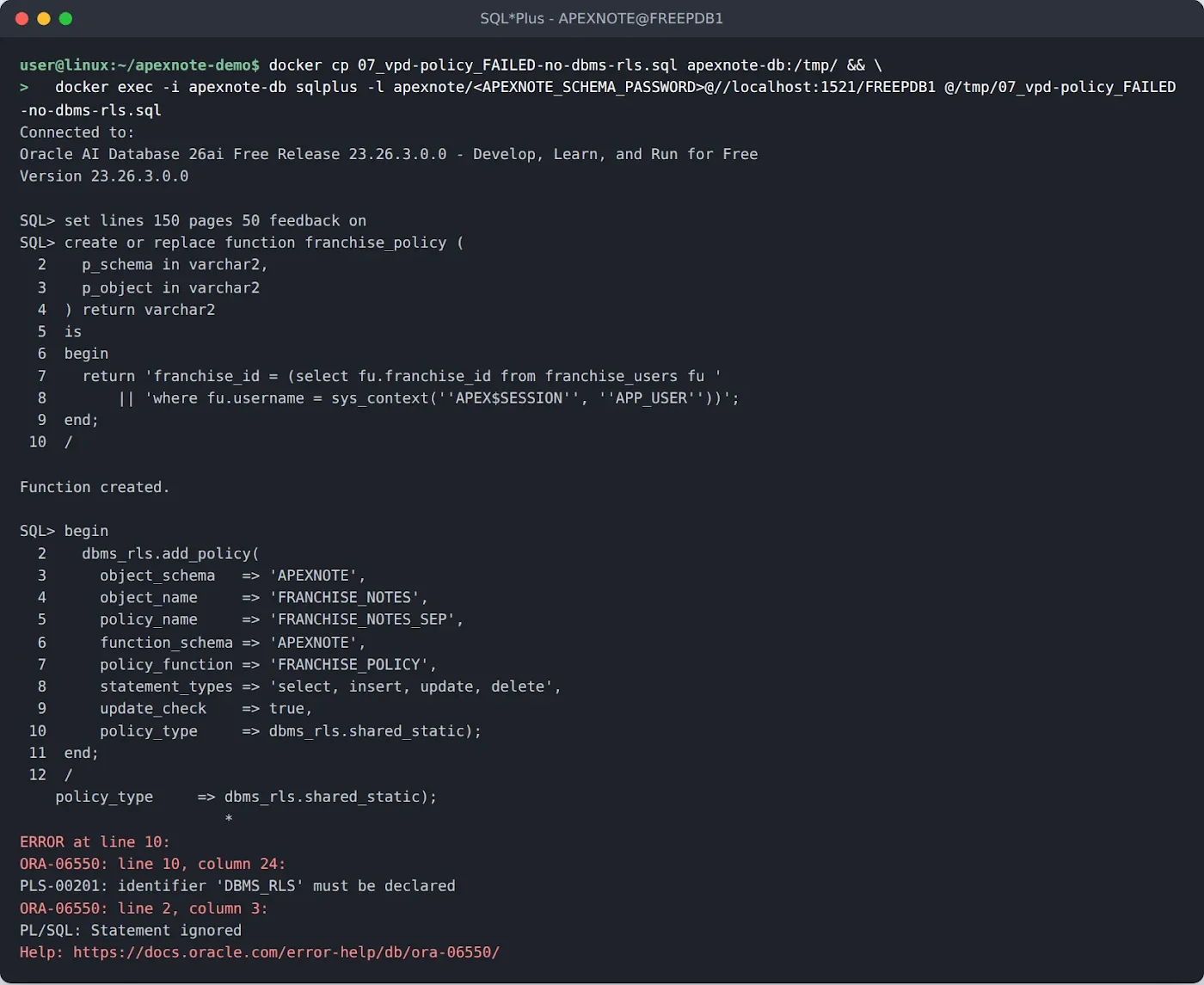

grant execute on dbms_rls both tables have a policy for all four statement types. On Oracle AI Database 26ai Free this works without any extra option.Three settings matter here.
- The predicate fails closed. Without a logged-in APEX user the subquery finds no franchise, and the condition matches no row. A forgotten session means no data, not all data.
update_check => truealso checks new and changed rows. Nobody can write a row into another franchise.shared_staticruns the policy function once and caches the text. That is fine because the text itself never changes, only the value ofsys_contextat runtime.
Two Franchise Users
-- Two end users of the Task Board app, one per franchise.
set lines 150 pages 50 feedback on
begin
  apex_util.set_workspace(p_workspace => 'APEXNOTE');
  for u in (select username from franchise_users) loop
    apex_util.create_user(
      p_user_name                    => u.username,
      p_web_password                 => '<a_strong_user_password>',
      p_change_password_on_first_use => 'N');
  end loop;
  commit;
end;
/
col user_name format a20
select user_name, account_locked from apex_workspace_apex_users
 where workspace_name = 'APEXNOTE' order by user_name;
PL/SQL procedure successfully completed.

USER_NAME            ACC
-------------------- ---
APEXNOTE_ADMIN       No
DEMO_DEV             No
FRANKFURT_MANAGER    No
HAMBURG_MANAGER      No
Same Query, Three Users
This is the moment of truth. The query from step 5, not changed by a single character. For SQL*Plus I simulate the APEX login with apex_session.create_session, which fills the same APEX$SESSION context a real page request does.
-- The same query as in step 5, not changed by one character. Only the logged-in APEX user changes.
set lines 160 pages 50 feedback on
col franchise format a10
col customer format a26
col note format a62 trunc
col match_pct format 990
variable q varchar2(200)
exec :q := 'customer received the same invoice twice'

prompt === 1. No APEX session (a script, a report tool, a forgotten job)
with question as (
  select vector_embedding(apexnote_vec.all_minilm_l12_v2 using :q as data) as v from dual
)
select f.name as franchise, n.customer, n.note,
       round((1 - vector_distance(n.note_vec, question.v, cosine)) * 100) as match_pct
  from franchise_notes n
  join franchises f on f.id = n.franchise_id, question
 order by vector_distance(n.note_vec, question.v, cosine)
 fetch first 4 rows only;

prompt === 2. Same query, logged in as FRANKFURT_MANAGER
exec apex_session.create_session(p_app_id => 100, p_page_id => 1, p_username => 'FRANKFURT_MANAGER')
/

prompt === 3. Same query, logged in as HAMBURG_MANAGER
exec apex_session.delete_session
exec apex_session.create_session(p_app_id => 100, p_page_id => 1, p_username => 'HAMBURG_MANAGER')
/

prompt === 4. Hamburg asks for Frankfurt rows on purpose
select count(*) as frankfurt_rows_visible from franchise_notes where franchise_id = 1;

prompt === 5. Hamburg tries to write a note into Frankfurt
insert into franchise_notes (franchise_id, customer, note) values (1, 'Westend Law Office', 'test');
rollback;
exec apex_session.delete_session
=== 1. No APEX session (a script, a report tool, a forgotten job)
no rows selected

=== 2. Same query, logged in as FRANKFURT_MANAGER
FRANCHISE  CUSTOMER                   NOTE                                                           MATCH_PCT
---------- -------------------------- -------------------------------------------------------------- ---------
Frankfurt  Mainblick Dental Practice  The customer says the invoice for September arrived twice and         66
Frankfurt  Bockenheim Kita            Customer pays always 30 days late. Send a friendly reminder be        38
Frankfurt  Westend Law Office         Customer wants a fixed quote for window cleaning twice a year.        32
Frankfurt  Sachsenhausen Bakery       Contract renewal for next year agreed by phone, waiting for th        23

=== 3. Same query, logged in as HAMBURG_MANAGER
FRANCHISE  CUSTOMER                   NOTE                                                           MATCH_PCT
---------- -------------------------- -------------------------------------------------------------- ---------
Hamburg    Alster Tax Advisors        Customer reports that the October invoice was sent two times b        68
Hamburg    Speicherstadt Gallery      Last two invoices are still open, the customer asked for a pay        42
Hamburg    Altona Co-Working          Customer wants to double the cleaning hours, ask for a new off        38
Hamburg    Alster Tax Advisors        Cleaner came one hour late, the office was already full of cli        29

=== 4. Hamburg asks for Frankfurt rows on purpose
FRANKFURT_ROWS_VISIBLE
----------------------
                     0

=== 5. Hamburg tries to write a note into Frankfurt
ERROR at line 1:
ORA-28115: policy with check option violation

Who Can Still See Everything?
VPD binds every user, even the owner of the table. I ran all the tests above as APEXNOTE, the owner, and still got no rows without a session. Two kinds of users are not bound. SYS, and everybody with the system privilege EXEMPT ACCESS POLICY. Know that list.
-- VPD binds everybody, the table owner too. Only SYS and users with EXEMPT ACCESS POLICY see everything.
set lines 150 pages 50 feedback on
select count(*) as all_notes_seen_by_sys from apexnote.franchise_notes;
col grantee format a20
select grantee from dba_sys_privs where privilege = 'EXEMPT ACCESS POLICY';
ALL_NOTES_SEEN_BY_SYS
---------------------
                   20

GRANTEE
--------------------
SYS
GSMUSER_ROLE
GSMADMIN_INTERNAL
OGG_CAPTURE
-- What the database really runs: the policy predicate shows up in the plan, the query text never had it.
set lines 150 pages 80 feedback off
explain plan for
select customer, note from franchise_notes;
select plan_table_output from table(dbms_xplan.display(format => 'BASIC +PREDICATE'));
--------------------------------------------------------
| Id  | Operation                    | Name            |
--------------------------------------------------------
|   0 | SELECT STATEMENT             |                 |
|*  1 |  TABLE ACCESS FULL           | FRANCHISE_NOTES |
|   2 |   TABLE ACCESS BY INDEX ROWID| FRANCHISE_USERS |
|*  3 |    INDEX UNIQUE SCAN         | SYS_C0019002    |
--------------------------------------------------------

Predicate Information (identified by operation id):
---------------------------------------------------
   1 - filter("FRANCHISE_ID"= (SELECT "FU"."FRANCHISE_ID" FROM
              "APEXNOTE"."FRANCHISE_USERS" "FU" WHERE
              "FU"."USERNAME"=SYS_CONTEXT('APEX$SESSION','APP_USER')))
   3 - access("FU"."USERNAME"=SYS_CONTEXT('APEX$SESSION','APP_USER'))
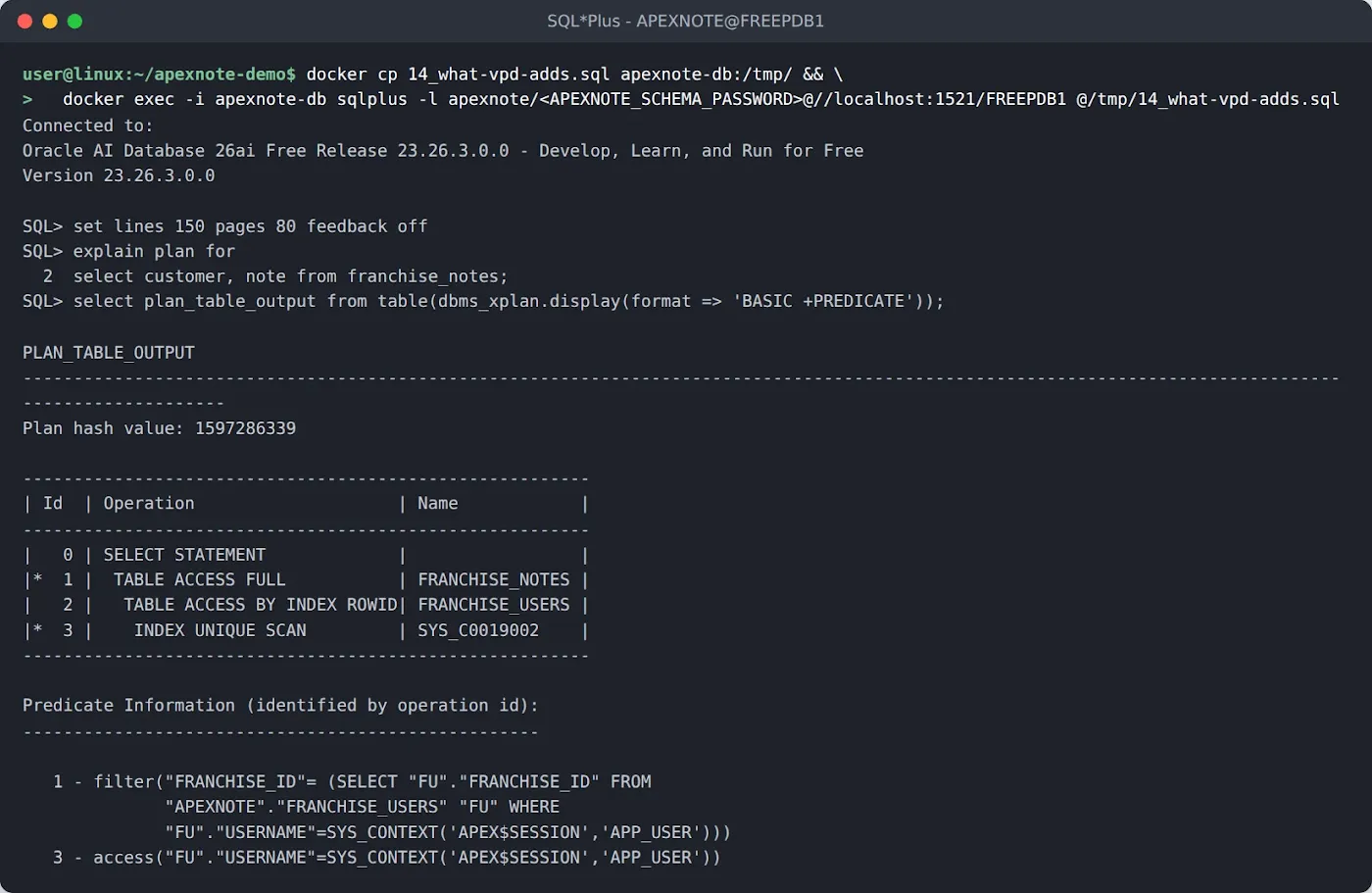
select customer, note from franchise_notes. The plan shows what the database really runs, with the franchise filter added by the policy.The APEX Page
In the app the page is a copy of the Smart Search page from part 3, pointed at the notes. One display item shows the user's franchise, and the report query has, again on purpose, no franchise filter.
-- no franchise filter here on purpose: the VPD policy adds it to every query
with question as (
  select vector_embedding(apexnote_vec.all_minilm_l12_v2 using :P5_SEARCH as data) as v
    from dual
)
select n.customer                                   as list_title,
       n.note                                       as list_text,
       to_char(round((1 - vector_distance(n.note_vec, question.v, cosine)) * 100), 'fm990') || ' %' as list_badge,
       'fa fa-comment-o'                            as icon_class,
       'u-info'                                     as icon_color_class,
       null as link, null as link_class, null as link_attr, null as list_class
  from franchise_notes n, question
 where vector_distance(n.note_vec, question.v, cosine) <= 0.75
 order by vector_distance(n.note_vec, question.v, cosine)
 fetch first 5 rows only
select f.name
  from franchise_users fu
  join franchises f on f.id = fu.franchise_id
 where fu.username = :APP_USER


frankfurt_manager. "Customer received the same invoice twice" finds Mainblick Dental Practice with 66 %. No Hamburg customer anywhere.
hamburg_manager. Alster Tax Advisors with 68 %. The page did not change, the user did.Part C. "Who Was My Strongest Customer?"
The third question. A manager does not want to search notes, they want numbers. Who was my strongest customer in the last three months, and how much did we make with them? Let me ask the semantic search first, because that is what people expect the "AI" to do.
Ask the Search, Then Ask SQL
-- "Who was my strongest customer?" First as a semantic search, then as plain SQL. Logged in as FRANKFURT_MANAGER.
set lines 160 pages 50 feedback off
exec apex_session.create_session(p_app_id => 100, p_page_id => 1, p_username => 'FRANKFURT_MANAGER')
col customer format a26
col note format a70 trunc
col match_pct format 990
with question as (
  select vector_embedding(apexnote_vec.all_minilm_l12_v2
           using 'who was my strongest customer in the last three months' as data) as v from dual
)
select n.customer, n.note,
       round((1 - vector_distance(n.note_vec, question.v, cosine)) * 100) as match_pct
  from franchise_notes n, question
 order by vector_distance(n.note_vec, question.v, cosine)
 fetch first 3 rows only;

col revenue format 999,990.00
select customer, count(*) as orders, sum(amount) as revenue
  from orders
 where order_date >= add_months(trunc(sysdate, 'MM'), -3)
 group by customer
 order by revenue desc
 fetch first 3 rows only;

exec apex_session.delete_session
exec apex_session.create_session(p_app_id => 100, p_page_id => 1, p_username => 'HAMBURG_MANAGER')
/
exec apex_session.delete_session
CUSTOMER                   NOTE                                                                   MATCH_PCT
-------------------------- ---------------------------------------------------------------------- ---------
Sachsenhausen Bakery       Floor in the sales room was still wet when the shop opened. A customer        31
Mainblick Dental Practice  The customer says the invoice for September arrived twice and was paid        30
Bockenheim Kita            Customer pays always 30 days late. Send a friendly reminder before the        29

CUSTOMER                       ORDERS     REVENUE
-------------------------- ---------- -----------
Ostend Fitness Studio               4   12,710.00
Westend Law Office                  4    9,840.00
Mainblick Dental Practice           4    7,585.00

-- same SQL, logged in as HAMBURG_MANAGER
CUSTOMER                       ORDERS     REVENUE
-------------------------- ---------- -----------
Altona Co-Working                   4   17,630.00
Alster Tax Advisors                 4   11,275.00
Eppendorf Physio Centre             4    8,610.00

The search is not broken. The question is simply not a search. "Strongest customer" means sum the orders per customer for a period and sort. That is arithmetic, and an embedding model does not do arithmetic. SQL does.
To ask that in plain language you need a second kind of AI, a language model. It reads the question, writes the SQL, the database runs it, and the model phrases the answer. This is often called text-to-SQL. There are two ways to run one.
| Option | Good | Watch out |
|---|---|---|
| External model (OpenAI, Anthropic, Google and others) | Very good SQL, nothing to host, works today | The question, the table structure and often the result rows leave your server. That is a processor and possibly a third-country transfer again. |
| Self-hosted model (open models on your own server) | Everything stays in-house, same as the embedding model | Needs real hardware, ideally a GPU, and smaller open models write weaker SQL. Plan for testing. |
Whatever writes the SQL, a developer or a language model, the SQL must run with the rights of the logged-in user, read-only, on tables protected by VPD. Then even a perfectly wrong or manipulated query can only ever see the user's own franchise. The model never gets rows it was not allowed to read, so it can not tell anybody about them.
Troubleshooting. What Went Wrong
| Error | Where | Real cause | Fix |
|---|---|---|---|
| PLS-00201 identifier 'DBMS_RLS' must be declared | dbms_rls.add_policy as the app schema | No execute right on DBMS_RLS | grant execute on dbms_rls to apexnote as SYS |
| ORA-24247 network access denied by access control list | utl_http.request as the app schema | No entry in dba_host_aces. Here it is the point of the test. | Nothing. Grant a host ACE only for hosts you really need. |
| ORA-28115 policy with check option violation | Insert into another franchise | update_check => true | Works as designed |
| ORA-28115 on every row of a seed script | Re-running the sample data script after the policy was active | No APEX session, so no franchise, so no row is allowed | Load data with a real user session, or from a separate admin process you trust |
| A test row landed in the wrong franchise | SQL*Plus / right after exec | / re-runs the last SQL statement in the buffer, which was my failed insert, now as the other user | Never use / after exec in test scripts. I deleted the row and rewrote the script. |
Checklist Before You Go Live
- Every tenant table has a policy. Notes, orders, invoices, attachments, and every table with a vector column. A forgotten table is a forgotten
WHEREagain. - Fail closed. Without a known user the predicate must match nothing. Test it with a session that has no user.
- Know who bypasses. Check
EXEMPT ACCESS POLICYand keep application code away fromSYSand DBA accounts. - Other entry points. REST endpoints, scheduler jobs and reports run without an APEX page request. They need the same context, or they correctly see nothing.
- Outgoing network. Read
dba_host_aces. Only hosts you need, only for the schemas that need them. - Vector indexes. With an approximate index the policy filter is applied on top of the index search. Test with real data per tenant that you still get enough results.
Semantic search, duplicate detection and smart suggestions that run inside your Oracle database, with tenant separation built in. For franchises, branches and every app where customers must never see each other's data. Get in touch.
What Comes Next
- A context for everything else. An own application context, set by REST handlers and jobs, so the same policy protects ORDS endpoints too.
- Language model on top. Text-to-SQL that runs as the logged-in user, read-only, on VPD tables. External or self-hosted, the rule from part C stays the same.
- Audit. Unified auditing on the policy tables, so you can show who searched what, if a customer ever asks.
Final Thoughts
The most useful thing I learned building this is where the risk really sits. People are afraid of the AI. The AI in this post is a 127 MB file that turns text into numbers and forgets everything right after. The risk was always the query around it, and that risk existed long before anybody said "AI".
Virtual Private Database moves the franchise filter from every single query into one place in the database. It took one grant, one function and two policy calls, and it works on the Free edition. After that the leak from step 5 was impossible, not just unlikely.
If you run a franchise or a multi-tenant APEX app and want to try this on your own data, write to me. I read every message.
{fullWidth}